
Traceability marking and security features on tobacco products
On this page you will find information about the rules that apply to traceability and security markings on tobacco products. Manufacturers, importers, wholesalers or retailers of tobacco products must apply for unique identifier codes and ensure that the outer packaging of the tobacco product has a unique traceability marking and security feature.
Traceability of tobacco products
The traceability system was implemented in May 2019 to combat the illicit trade of tobacco products. To further combat illicit trade, unit packs of tobacco products must also be equipped with a security feature.
The traceability system
In short, the traceability system means that all operators, facilities and machines involved in the manufacturing and supply chain of tobacco products have a unique identifier code. All tobacco products have a unique identity marking, also known as a traceability marking. When unit packs are handled and transported, these events must be registered, and the information transferred to a central database. Economic transactions related to the tobacco products are also registered in the database system.
The unique identity marking and its associated human-readable code are generated and issued by the competent ID issuer. Tobacco products lacking traceability and security markings may not be sold.
Figure 1. System structure of the traceability system.
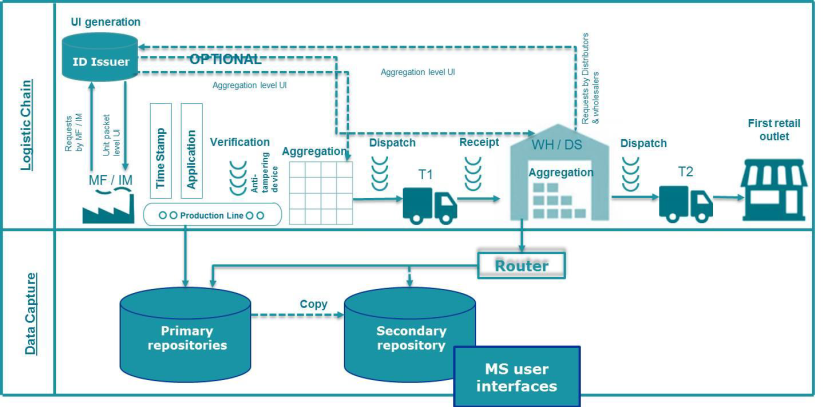
Source: The image is taken from The commissions stakeholder manual, Systems of traceability and security features for tobacco products in the EU (health.ec.europa.eu).
The Secondary repository and primary repository
Each manufacturer and importer must establish a primary repository where all traceability data for their own products is stored.
The secondary repository is a central database containing a copy of all traceability data stored in the primary repositories.
The Commission has appointed Dentsu International Switzerland AG as the provider of the secondary repository. More information about and from the provider is available on the European Commission’s website:
Systems for tobacco traceability and security features (ec.europa.eu)
The provider of the secondary repository provides technical specifications and the common data catalogue for the traceability system. These are available on the Dentsu International website.
The EU Secondary Repository Resources Center (eu-secondary.dentsuaegistracking.com)
National ID issuer and identifier codes
All economic operators participating in the supply chain for tobacco products released on the Swedish market must have a unique identifier code, both as an economic operator and for the facilities, machines, and machine parts. These codes, as well as the unique identifiers on the tobacco products, are issued by the national ID issuer.
In Sweden, The Public Health Agency of Sweden is designated as the national ID issuer, with the authority to delegate this assignment to a private entity. The Agency has signed an agreement with the Slovak company All Soft Corp s.r.o. to act as the national ID issuer.
All Soft Corp’s unique identifier code is QCALL. All identification codes and unique identifiers they issue start with this code.
Competent ID issuer
The European Commission’s Implementing Regulation 2018/574 contains further rules on which member state’s ID issuer is competent in each country. The Commission’s website provides a list of competent ID issuers in each member state.
Systems for tobacco traceability and security features/Competent ID issuers (ec.europa.eu)
Format for unique identifiers
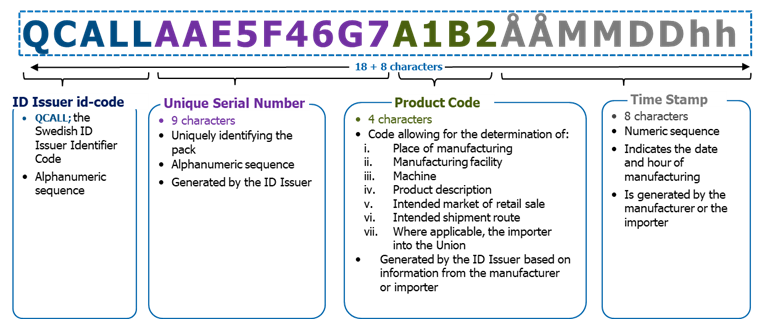
The unit level unique identifiers (UIs), generated by the ID issuer, consists of 18 characters, to which a date stamp of 8 characters is added, making a total of 26 characters.
The unique identifier consists of four parts:
- ID issuer's code; according to ISO14549-2, 5 characters (QCALL).
- Unique serial number; according to ISO646, consists of [a-z; A-Z; 0-9), a total of 9 characters.
- Product code, consists of [a.z; A-Z; 0-9), a total of 4 characters, the code makes it possible to determine:
- i: Place of manufacture
- ii: Manufacturing facility (identification code)
- ii:. Manufacturing machine (identification code)
- iv: Product description (type, brand, weight, etc.)
- v: Intended market (country)
- vi: Intended delivery route (cross-border transport, first country after manufacture/import to the EU)
- vii: The importer into the Union, where applicable
- Time stamp, format YYMMDDhh, total 8 characters, indicates the time of manufacture as above, generated by the manufacturer or importer.
Figure 1. The four parts of the unique identifier.
To simplify the registration of the tobacco products, aggregated packages can be marked with aggregated level unique identifiers (aUI).. The aggregated unique identifiers can be created by the economic operators themselves or by the competent ID issuers after an application for aggregated identifiers from the economic operator.
The aggregated unique identifier must follow the structure in Article 11.1 if generated by the authorized ID issuer. If created by the economic operator it shall consist of an individual code for each generated aggregated unit in accordance with ISO/IEC 15459-1:2014 or ISO/IEC 15459-4:2014 or their latest equivalents.
Information and instructions for encoding and decoding aggregated level UIs is available on the ID issuer webpage, under the section Documents.
Direct link to the encoding and decoding document: Encoding of Unique Identifiers (idissuer.se)
Security features on tobacco products
On this page you can see examples of the security features that are used on the Swedish market:
Security features with authentication elements on tobacco products
Obligations and responsibilities of different operators
Manufacturers and importers of tobacco products are responsible for several important aspects of the traceability system, including traceability marking. Manufacturers are also responsible for providing equipment for the registration of events to all actors in the distribution chain, except retailers.
-

Traceability and security features – This applies to manufacturers and importers of tobacco products
Traceability and security features. This publication outlines the requirements that apply to you as a manufacturer or importer of tobacco products.
-
Traceability and security features – This applies to retailers of tobacco products
Traceability and security features. In this publication, you can read about the requirements that apply to you as a retailer of tobacco products.
-
Traceability and security features – This applies to wholesalers and distributors of tobacco products
Traceability and security features. In this publication, you can read about the requirements that apply to you if you are a wholesaler or distributor of tobacco products.
Information from the European Commission
The European Commission's website on traceability and security features is regularly updated with important information for the stakeholders. The Commission has compiled a document containing extracts from the summaries (in English) of the meetings of the Traceability and Security Features Subgroup (from February 2018 until November 2021) and questions and answers on traceability and security features. Summaries from subsequent Subgroup meetings are also published on the website.
- Systems for tobacco traceability and security features (health.ec.europa.eu)
- Compilation of questions and answers and expert subgroup discussions concerning the EU systems for traceability and security features of tobacco products (health.ec.europa.eu)
It is important that all events are reported in the order of occurrence and that the correct information is transferred to the system in the correct way. The Commission has collected common mistakes and how they should be corrected in a document to assist economic operators when reviewing their reporting practices:
EU system of tobacco product traceability: Common reporting mistakes (health.ec.europa.eu)
You need to have knowledge of the legislation
The information on this website is only intended to serve as an aid to you, and does not replace what is stated in the legislation. There may also be laws or regulations of other authorities that you need to be aware of. We continuously update the content but we cannot guarantee that the information on the page is always up-to-date.