
Recommendations about vaccination against tick-borne encephalitis (TBE)
About the publication
The Public Health Agency of Sweden (PHAS) issues recommendations on vaccination against tick-borne encephalitis (TBE), as presented in this document. These recommendations are not binding. Their aim is to reduce the incidence of TBE-related illness, death, and long-term sequelae in Sweden, thereby contributing to improved public health.
To support regional decision-making on TBE vaccination, PHAS has conducted a health economic analysis. The findings are summarized in English in the report:
Hälsoekonomisk analys av vaccination mot TBE (in swedish)
The recommendations were published in May 2026.
Public Health Agency of Sweden
Olivia Wigzell
Director-General
Vaccination against tick-borne encephalitis
Tick-borne encephalitis (TBE) is an infectious disease caused by the tick-borne encephalitis virus, a flavivirus that is mainly spread via tick bites. The disease can cause severe neurological symptoms, long-term residual symptoms and, in rare cases, death. TBE can occur at any age but most cases are reported in the 50–59 age group. The incidence of TBE in Sweden has increased by approximately 6 per cent over the last 10 years. A warmer climate is leading to a longer tick season and more ticks, which is contributing to the disease spreading to new areas, including further north.
There are two vaccines approved in Sweden: FSME-Immun and Encepur. Both vaccines are safe and provide good protection. The vaccines have been on the market in Sweden for approximately 30 years and, with certain exceptions, those taking the vaccine have paid for it themselves. There are no exact figures concerning vaccination coverage as there is no national register of TBE vaccinations, but it is estimated that roughly half of the population in certain areas with high incidence of TBE have taken the vaccine. The World Health Organization (WHO) recommends the vaccination of people of all ages where TBE is highly endemic (average annual pre-vaccination incidence ≥ 5 cases/100,000 population). This investigation calculates the incidence of TBE among unvaccinated inhabitants of several areas of Sweden to exceed 20 per 100,000, and that large areas around Sweden’s three largest lakes have an incidence of TBE above 5 per 100,000.
Between 250 and 350 people are hospitalised with TBE in Sweden each year. Long-term residual symptoms are common among those who have been treated in hospital. Approximately 30,000 days of sick leave due to TBE were registered annually during the period 2021–2025.
In its investigation, the Public Health Agency of Sweden has assessed the medical benefits of vaccination against TBE in Sweden, and at what incidence of TBE the likelihood of infection is so high that vaccination should be recommended. The recommendation is based on the proven benefit of vaccination in terms of preventing infection; it does not give any consideration to how vaccinations should be financed. It is the assessment of the Public Health Agency of Sweden that TBE vaccination is an effective measure for preventing serious illness and the long-term residual symptoms of TBE. This document presents the areas in which vaccination is recommended and suitable intervals between doses.
TBE vaccines are not included in the national vaccination programme. With a few exceptions, vaccines that are not covered by the national programme are paid for by the individual. This is the case regardless of whether the Public Health Agency of Sweden recommends vaccination. Regions may decide to subsidise vaccination, something that from a health economics perspective would be especially relevant in areas where the burden of disease is high. To facilitate regional decisions concerning any future funding of TBE vaccination, we have conducted a cost-effectiveness analysis of vaccination at various rates of incidence. According to this analysis, at a pre-vaccination incidence of 12 per 100,000, the cost per gained Quality-Adjusted Life Year (QALY) is lower than SEK 500,000 for vaccinating 25-year-olds. The corresponding incidence for 3-year-olds is 19 per 100,000.
The Public Health Agency of Sweden’s recommendations concerning vaccination against TBE
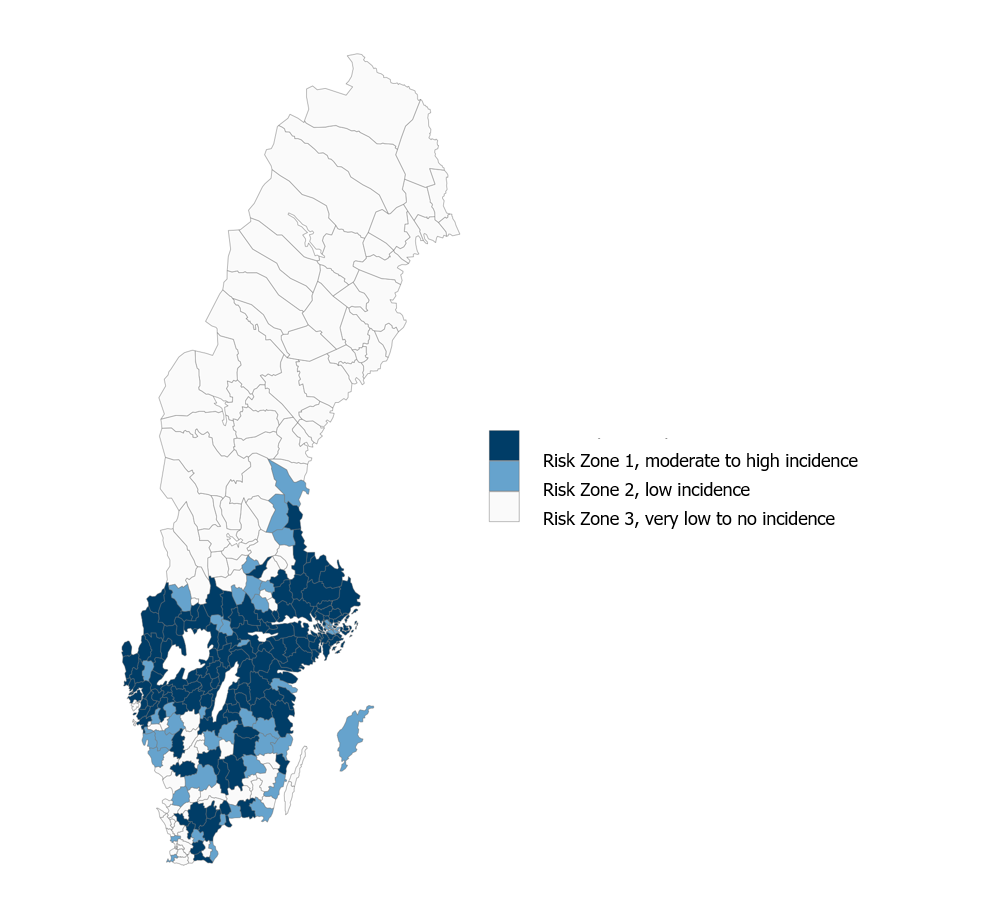
The Public Health Agency of Sweden’s recommendations are based on a map of risk areas for TBE infection, see Figure 1. Risk Zone 1 has a moderate to high incidence of TBE (defined as an incidence of over 5 cases per 100,000 in the unvaccinated population during 2021-2025); Risk Zone 2 has a low incidence of TBE (defined as an incidence of over 1 case per 100,000 in the unvaccinated population during any five-year period since 2004); Risk Zone 3 has no or low incidence of TBE (defined as less than 1 case during all five-year periods since 2004). Risk Areas 1 and 2 cover central and southern parts of Sweden, including the areas around Lake Mälaren and the coastal regions of eastern and western Sweden.
- Regions with municipalities in Risk Area 1; Blekinge, Dalarna, Gävleborg, Halland, Jönköping, Kalmar, Kronoberg, Skåne, Stockholm, Södermanland, Uppsala, Värmland, Västmanland, Västra Götaland, Örebro, and Östergötland.
- Regions with municipalities in Risk Area 2; Blekinge, Dalarna, Gotland, Gävleborg, Halland, Jönköping, Kalmar, Kronoberg, Skåne, Stockholm, Värmland, Västmanland, Örebro, and Östergötland.
- Regions with municipalities in Risk Area 3; Dalarna, Gävleborg, Halland, Jämtland, Jönköping, Kalmar, Kronoberg, Norrbotten, Skåne, Stockholm, Värmland, Västerbotten, Västernorrland, Västmanland, and Västra Götaland.
Figure 1. Map of TBE risk areas in Sweden.
The Public Health Agency of Sweden recommends vaccination against TBE to:
- adults and children from three years of age at risk of tick bite in Risk Zone 1; and
- immunocompromised persons who live in or regularly visit Risk Zones 1 or 2 or a municipality that borders on these zones.
Number of doses and intervals
For adults under 50 years of age and children over 3 years of age, the Public Health Agency of Sweden recommends primary vaccination with two doses with an interval of one to three months and a third dose five months to one year after dose 2.
For adults of 50 years of age or over and immunocompromised persons, the Public Health Agency of Sweden recommends an extra dose one month after dose 1 in the primary vaccination course, meaning a total of four doses in the primary vaccination course.
The first booster dose should be administered three years after the last dose of primary vaccination. Thereafter, the Public Health Agency of Sweden recommends that booster doses are given every tenth year to all individuals that have received four doses prior to the age of 50. The Public Health Agency of Sweden recommend that those who receive at least one of their first four doses of vaccine after the age of 50, and immunocompromised persons, are given booster doses at five-year intervals after dose 5.
Vaccination in areas with a low incidence of TBE
Adults and children from three years of age at risk of tick bite in Risk Zone 2 can also benefit from vaccination, especially if they suffer many tick bites. However, the Public Health Agency of Sweden stops short of issuing a formal vaccination recommendation in this zone, as the risk of being infected with TBE is generally low.